

How to Match Circular Bag Capacity With the Density of Your Products
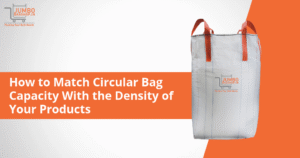
Choosing the right circular bag involves more than checking its dimensions or weight rating. You also need to understand the density of the material you plan to store or transport. A bag that works well for lightweight agricultural products may not suit a denser material, even if both products occupy the same amount of space.
Matching Circular Bag Capacity with product density helps businesses select suitable packaging, avoid overloading, and make better use of storage and transportation space. Whether you handle grains, sugar, cement, minerals, or other dry bulk materials, understanding the relationship between volume, density, and weight can simplify your purchasing decision.
Jumbobagshop is an online shopping destination where businesses can explore available circular or tubular FIBC bags and compare product dimensions, Safe Working Load (SWL), and other specifications before ordering. This guide explains how to calculate your capacity requirements and choose a suitable bag for your products.
What Is Circular Bag Capacity?
Circular bags, also known as tubular FIBC bags, are flexible bulk packaging containers made from fabric woven in a circular construction. They are commonly used to store and transport dry, flowable materials across industries such as agriculture, construction, food processing, and chemicals.
Circular Bag Capacity refers to how much material a bag can accommodate. However, capacity involves two different measurements:
-
Volume capacity: The amount of space available inside the bag, usually measured in cubic metres (m³) or litres.
-
Weight capacity: The maximum permitted load, specified by the bag’s Safe Working Load (SWL), usually measured in kilograms.
These measurements are related, but they are not interchangeable. A bag may have enough internal volume for a particular product but still exceed its permitted weight limit when filled.
For example, Jumbobagshop lists circular bags in dimensions such as 90 × 90 × 90 cm, 90 × 90 × 120 cm, and 90 × 90 × 150 cm, with selected products rated for 1,000 kg or 1,250 kg. Always check the individual product listing because dimensions and weight ratings vary.
Understanding Product Density Before Choosing a Circular Bag
Product density describes how much mass a material contains within a given volume. It plays an important role in determining how much material a bag can hold before reaching its weight limit.
For bulk packaging, you will often use bulk density, which measures the mass of a loose material divided by the volume it occupies, including the spaces between its particles.
For example, a cubic metre of fine powder may weigh considerably more than a cubic metre of a lightweight agricultural product. Therefore, two bags with identical dimensions can hold different weights depending on the material.
Consider these general examples:
-
Sugar and grains: Their bulk density varies with particle size, moisture, and how the material settles.
-
Cement and minerals: These materials may have higher bulk densities, depending on the specific product and its condition.
-
Plastic granules: Their density varies according to the polymer type, particle shape, and packing arrangement.
-
Agricultural products: Grains, seeds, and other materials can vary in density because of moisture, variety, and processing.
Never rely on a general density value when selecting a bag for an actual shipment. Use the measured or supplier-provided bulk density of your specific material.
How to Calculate Circular Bag Capacity
A simple calculation can help you estimate whether a bag’s volume suits your product and whether the resulting weight falls within the bag’s permitted load.
Step 1: Calculate the Approximate Bag Volume
For a preliminary estimate, multiply the bag’s listed length, width, and height after converting the measurements into metres.
Formula:
Approximate bounding volume = Length × Width × Height
For example, consider a circular bag listed as 90 × 90 × 120 cm.
-
Length: 0.90 m
-
Width: 0.90 m
-
Height: 1.20 m
The calculation is:
0.90 × 0.90 × 1.20 = 0.972 m³
This gives a bounding-volume estimate of 0.972 cubic metres.
Important: This calculation does not establish the exact usable internal capacity of a circular bag. Its flexible shape, construction, filling level, and product characteristics affect the actual volume it can hold. Use the product’s stated capacity when available, or obtain the appropriate specifications before purchasing.
Step 2: Determine the Product’s Bulk Density
Next, identify the bulk density of your material in kilograms per cubic metre (kg/m³).
For this example, assume the product has a bulk density of 650 kg/m³. This is an illustrative value, not a standard density for any particular material.
Step 3: Estimate the Product Weight
Multiply the usable volume by the material’s bulk density.
Formula:
Estimated product weight = Usable volume × Bulk density
Using the example above, if the full 0.972 m³ were usable:
0.972 × 650 = 631.8 kg
The estimated product weight would be 631.8 kg.
Because the calculated bounding volume may differ from the actual usable capacity, treat this result as a preliminary estimate rather than a final loading limit.
Step 4: Compare the Result With the Safe Working Load
Now compare the estimated filled weight with the SWL stated in the product listing.
If a suitable bag has an SWL of 1,000 kg, the estimated product weight of 631.8 kg falls below that limit. However, this alone does not confirm that the bag is suitable. You must also verify its actual usable volume, construction, material compatibility, filling method, and handling requirements.
Never exceed the bag’s rated SWL. Allow for any additional contents or components that contribute to the total load, and follow the product’s instructions.
How Product Density Affects Bag Capacity
Product density directly affects the amount of material a bag can hold by weight. When a material has a higher bulk density, it reaches the bag’s weight limit at a smaller volume. When a material has a lower bulk density, the bag may reach its volume limit before reaching its weight limit.
The following table illustrates this relationship using an assumed usable volume of 0.80 m³. These figures are examples for calculation purposes, not product-specific loading recommendations.
| Assumed bulk density | Estimated product weight in 0.80 m³ |
| 250 kg/m³ | 200 kg |
| 500 kg/m³ | 400 kg |
| 750 kg/m³ | 600 kg |
| 1,000 kg/m³ | 800 kg |
| 1,250 kg/m³ | 1,000 kg |
For example, a material with a bulk density of 250 kg/m³ would weigh approximately 200 kg in 0.80 m³. A material with a bulk density of 1,000 kg/m³ would weigh approximately 800 kg in the same volume.
This comparison shows why businesses should evaluate both volume and weight before selecting circular bags for packaging.
Choosing the Right Circular Bag Size for Different Products
Different products require different combinations of volume, load capacity, and packaging features. Use the following guidance when comparing available options.
1. Circular Bags for Grains and Agricultural Products
Grains, seeds, and other agricultural products can vary in bulk density depending on their type, moisture content, and particle size.
When selecting a Circular Bag Size, consider the quantity you need to store, the material’s measured bulk density, and the intended storage or transportation method.
Check that the bag’s dimensions provide sufficient volume without exceeding its SWL. Also consider the filling and discharge arrangements needed for your operation.
2. Circular Bags for Sugar and Similar Products
Sugar and other dry, flowable products may require careful attention to particle size, moisture exposure, and leakage prevention.
Compare the bag’s top and bottom configurations with your filling and unloading processes. If the material requires additional protection from moisture or contamination, check the listed product specifications to confirm whether the bag’s features meet those requirements.
Do not assume that every circular bag provides the same level of protection or containment.
3. Circular Bags for Cement and Minerals
Cement, minerals, and similar materials can place substantial weight in a relatively small volume, depending on their bulk density.
Calculate the expected filled weight before selecting a bag. Then compare the result with the bag’s SWL and verify that its dimensions accommodate the required quantity.
For fine powders, also review the product’s construction and relevant containment features. Select a bag that suits the material and the conditions in which you will handle it.
4. Circular Bags for Plastic Granules
Plastic granules vary in bulk density depending on the polymer, granule shape, and packing arrangement.
Estimate the total weight of the intended quantity and compare it with the available bag dimensions and rated capacity. Also consider whether the granules need protection from moisture, dust, or contamination.
If the product requires electrostatic protection, confirm that the selected bag is specifically suitable for that application. Standard circular bags are not automatically appropriate for every electrostatic-risk environment.
Common Mistakes to Avoid When Matching Capacity With Product Density
A few common errors can lead to unsuitable packaging choices or inaccurate capacity estimates.
Choosing a bag by dimensions alone: The same dimensions can produce different filled weights for materials with different bulk densities.
Confusing volume with SWL: A bag’s geometric volume does not indicate its maximum permitted load.
Using the wrong density value: Particle size, moisture, and settling can change a product’s bulk density. Use a value appropriate to the material’s actual condition.
Assuming the entire bounding volume is usable: Flexible bags do not always fill their calculated length × width × height volume.
Ignoring product compatibility: The bag’s construction and protective features must suit the contents and intended application.
Overlooking handling requirements: Consider lifting equipment, filling and discharge methods, and storage conditions before choosing a product.
Avoiding these mistakes helps you compare available bags more accurately and make informed purchasing decisions.
Why Check Circular Bag Specifications Before Buying Online?
Comparing product specifications before placing an order helps you identify bags that match your material, capacity requirements, and operating conditions.
At Jumbobagshop, customers can browse available tubular or circular bags online and review specifications such as:
-
Length, width, and height
-
Safe Working Load
-
Safety Factor
-
Top and bottom configurations
-
Bag construction and other listed features
Use these details alongside your product density and volume calculations to narrow down the available options. If you handle several materials, assess each one separately rather than assuming a single bag will suit every application.
Explore the available options on the Jumbobagshop circular and tubular bags page and review the individual product specifications before purchasing.
Conclusion
Matching circular bag capacity with product density helps businesses choose suitable bulk packaging for their materials. Start by determining the required quantity, measuring or obtaining the product’s bulk density, and estimating the volume needed. Then compare the result with the bag’s usable capacity and stated Safe Working Load.
Remember that a bag must meet both volume and weight requirements. You should also check material compatibility, construction, filling and discharge arrangements, and handling conditions before making a final selection.
Jumbobagshop makes it convenient to browse available circular bags online and compare product specifications. By evaluating these details carefully, you can make a more informed purchasing decision for your packaging and transportation needs.